

ISSP Stay report of Prof. RONETTI, Flavio
Flavio Ronetti
CPT, CNRS, Aix-Marseille Université, France

I had the great pleasure of visiting the group of Professor Takeo Kato at the Institute for Solid State Physics (ISSP), the University of Tokyo, during the summer of 2026. During my stay, I collaborated with Professor Kato and Professor Masayuki Hashisaka on quantum transport, entanglement, and anyonic statistics. The opportunity to combine theoretical discussions with experimental perspectives made this visit particularly rewarding, both scientifically and personally.
My research during the visit focused on two main directions. The first concerned the relationship between quantum entanglement and Hong–Ou–Mandel (HOM) noise in interacting quantum Hall edge channels. In these systems, interactions cause an injected electronic excitation to split into collective modes propagating at different velocities. We investigated how the quantum correlations between these modes can be characterized through the Rényi entanglement entropy, and what information about this entanglement can be accessed through electrical noise measurements. In particular, we examined the conditions under which a quantity constructed from HOM noise provides a lower bound on the entanglement entropy. This work connects concepts from quantum information with experimentally accessible observables in electron quantum optics.
The second direction concerned the Ω-junction, a geometry in which a quantum Hall edge bends into a loop and quasiparticles can tunnel between two points along the same edge. We studied its extension to the Abelian fractional quantum Hall state at filling factor 2/5, as well as to non-Abelian states. Our aim was to understand how quasiparticle statistics appear in transport observables when the edge contains several modes and, in the non-Abelian case, additional neutral degrees of freedom and distinct fusion channels. These investigations contribute to the broader effort to identify experimentally accessible signatures of anyonic braiding. Throughout both projects, discussions with Professors Kato and Hashisaka helped refine the theoretical questions and assess their relevance to quantum Hall experiments.

Alongside this research, I participated in the ISSP International Workshop and Symposium, “New Frontiers in Spintronic and Mesoscopic Physics” (NFSMP2026), where I gave two invited talks. The meeting’s emphasis on extended discussions created an excellent setting for exchanging ideas with researchers working on quantum transport and mesoscopic physics. I also presented a talk at the 37th International Conference on the Physics of Semiconductors (ICPS2026), which offered an opportunity to share my research with a broader international community.
During my stay, I visited Dr. Norio Kumada at NTT Basic Research Laboratories and Professor Toshimasa Fujisawa at the Institute of Science Tokyo, formerly Tokyo Institute of Technology. These visits provided valuable opportunities to discuss theoretical proposals alongside experimental developments in quantum Hall systems. Such exchanges help identify promising observables, understand experimental constraints, and develop research questions of shared interest. They also strengthened connections with Japanese colleagues and opened opportunities for future collaborations.
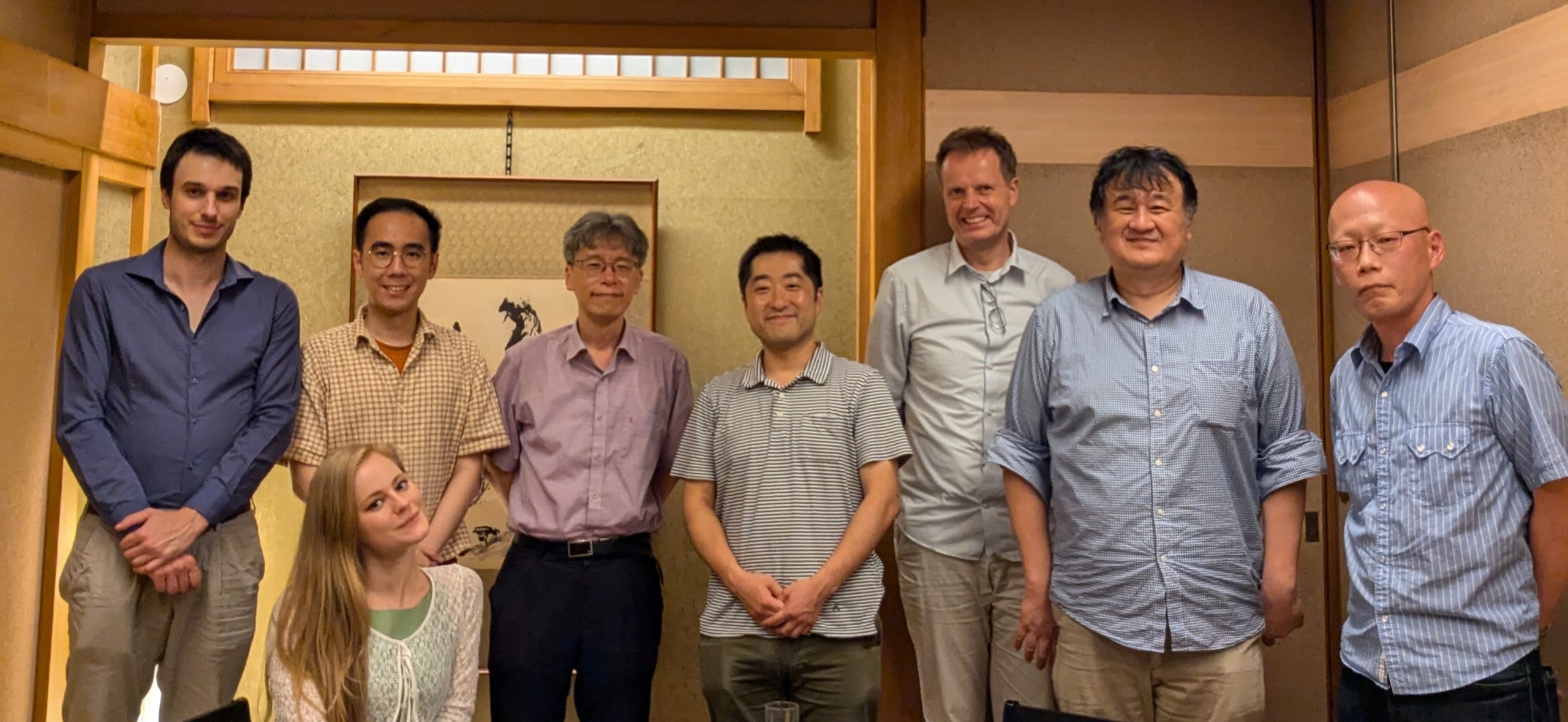
Beyond research, living in Japan gave me the opportunity to become more familiar with Japanese daily life and academic culture. The welcoming atmosphere at ISSP, together with the many informal conversations with colleagues, made this extended stay a memorable experience.
I am sincerely grateful to Professor Takeo Kato for his hospitality, his support, and the many stimulating discussions throughout my visit. I also warmly thank Professor Masayuki Hashisaka for his collaboration and for sharing his experimental insights on both projects, as well as the members of their groups for their warm welcome. I would like to close this report with a special thank-you to Yuko-san of the International Liaison Office and Eguchi-san for their kindness and support throughout my stay. Their help and thoughtfulness made my time at ISSP all the more enjoyable and memorable. I look forward to continuing our collaboration and to returning to ISSP in the future.
関連ページ
- 東京大学物性研究所 加藤研究室
- 東京大学物性研究所 橋坂研究室