

Yoshinobu Group

- Affiliation
- Division of Diverse Condensed Matter Science
- Courses
- Chem., Sci.Adv. Mat., Frontier Sci.
Research Subjects
- Activation and surface reaction of molecules on well-defined model catalysts
- Electronic states and reactivity of edge surfaces of two-dimensional materials
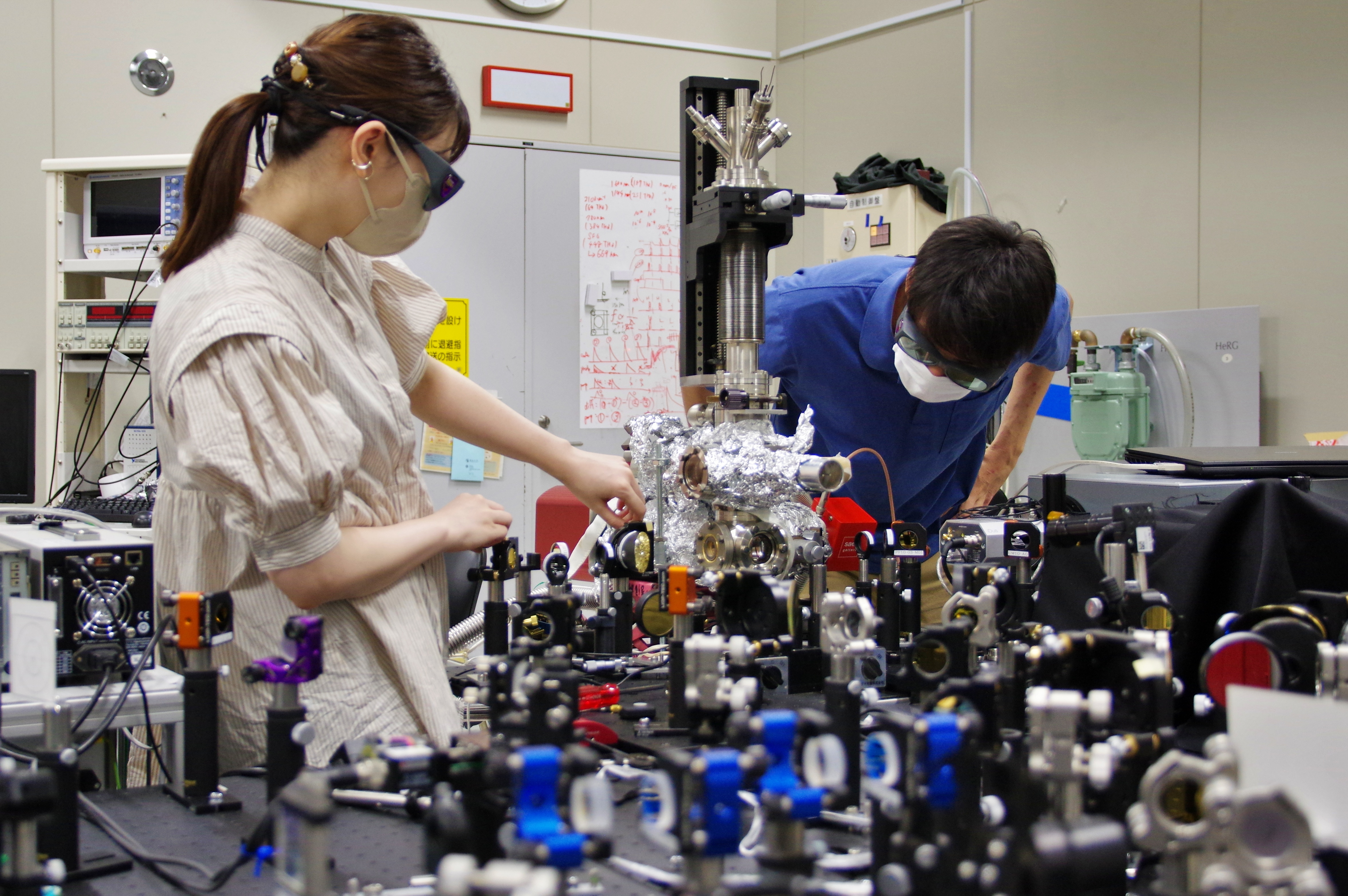
- Vibrational spectroscopy and dynamical processes of molecules on surfaces using THz pulses
- Spectroscopic study of materials surfaces reacted with neutral particles and plasma
The most important characteristic of solid surfaces is that they serve as “reaction sites” where atoms and molecules can be supplied from the outside to fabricate new materials. Surfaces and interfaces are important not only as the sites of mass transfer but also as the energy conversion sites. To control mass transfer at the atomic scale and create functional materials and devices, it is essential to understand the fundamental processes occurring at surfaces and interfaces. Research about the interactions of atoms and molecules with surfaces provides insights not only into catalysts and devices but also into chemical reactions in the environments in Earth and space. In our laboratory, we investigate the kinetics and dynamics of atoms and molecules on solid surfaces, as well as the structure, properties, and reactions of model catalysts and low-dimensional materials and the interactions between material surfaces and plasma, using vibrational spectroscopy, photoelectron spectroscopy, and scanning tunneling microscopy as well as DFT calculations. We are also advancing operando photoelectron spectroscopy using synchrotron radiation and we have engaged in time-resolved spectroscopy and the control of chemical processes using ultra-broad band THz pulses.