


Organization and Administration
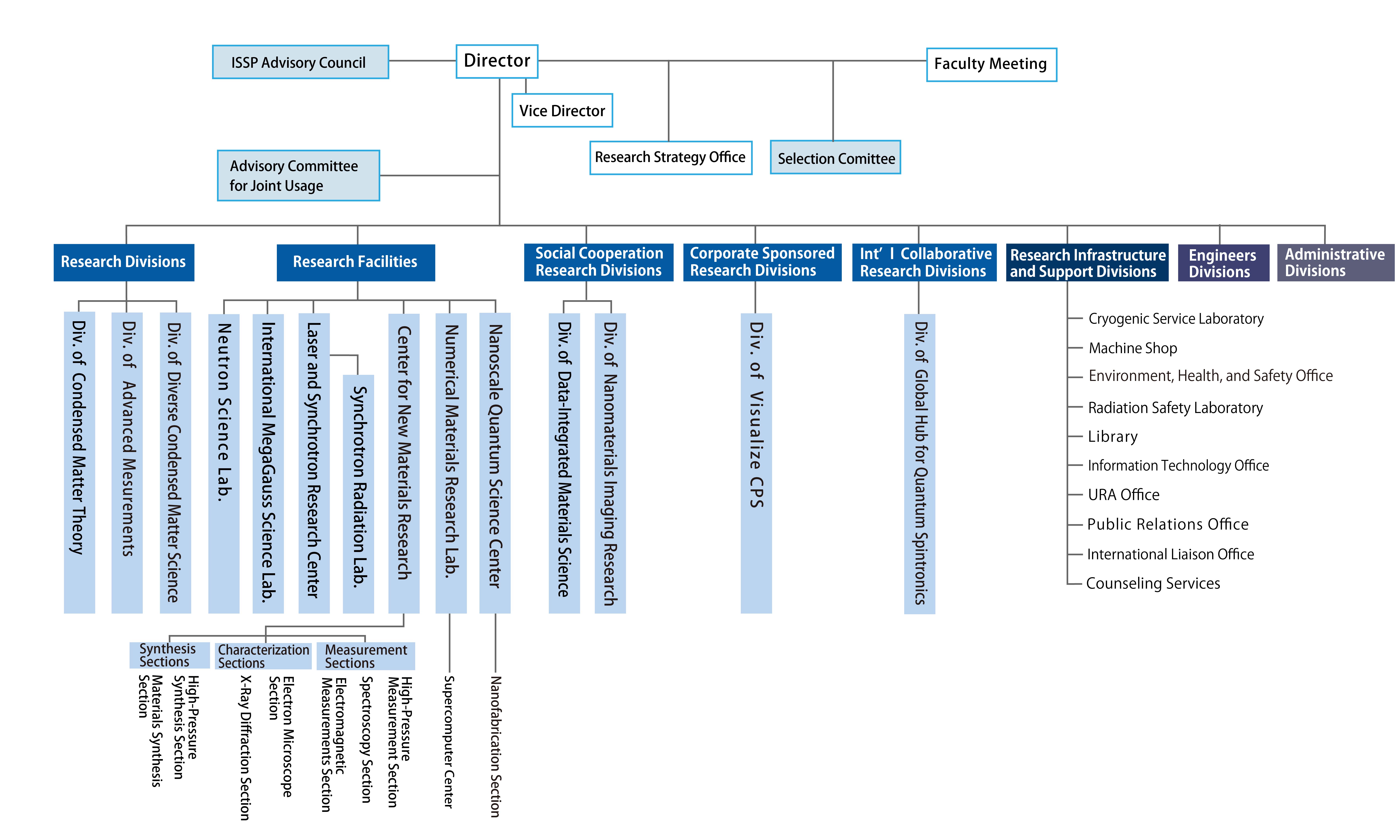
ISSP is organized into three Research Divisions, six Research Facilities, two Social Cooperation Research Divisions, the Corporate Sponsored Research Divisions, and the International Collaborative Research Divisions. Among these, the Laser and Synchrotron Research Center operates across three sites: Kashiwa, Harima(within SPring-8), and Sendai(within NanoTerasu). The experimental instruments of the Neutron Science Laboratory are installed at the JRR-3 research reactor and at J-PARC, both located within the Japan Atomic Energy Agency in Tokai, Ibaraki.
Within ISSP, several core facilities support both in-house researchers and outside users. These include the Cryogenic Service Laboratory, the Machine Shop, the Environment, Health, and Safety Office, the Radiation Safety Laboratory, and the Library. In addition, the Information Technology Office provides network administration and user support; the URA Office is responsible for research and development management; and the Public Relations Office disseminates information about ISSP activities. The International Liaison Office offers support for organizing international workshops and for assisting visiting researchers from abroad, and Counseling Services are available to students, faculty, and staff.
Personnel, Number of Faculty and Staff
ISSP openly recruits all positions for professors, associate professors, and research associates. ISSP`s hiring of professors and associate professors is decided by Faculty Meeting. Prior to the Faculty Meeting, the Personnel Selection Council, (composed of nearly equal number of members from inside and outside of ISSP), reviews all candidates. All final hiring decisions of research associates positions are also decided by Faculty Meeting. Prior to the Faculty Meeting, the Personnel Selection Council makes recommendations after reviewing candidates provided by a selection committee.
| Position | Number | Details; Foreign nationals | Details; Female | Position | Number | Details; Foreign nationals | Details; Female |
|---|---|---|---|---|---|---|---|
| Prof. | 21 | 1 | 2 | Project Prof.* | 3 | 1 | 0 |
| Assoc. Prof. | 21 | 0 | 1 | Project Assoc. Prof. | 4 | 0 | 0 |
| Visiting Prof. | 1 | 0 | 0 | Visiting Assoc. Prof. | 0 | 0 | 0 |
| Research Associates | 38 | 5 | 4 | Project Research Associates | 6 | 2 | 1 |
| Project Researches | 46 | 18 | 3 | Technical Staff | 59 | 3 | 21 |
| Admin. Staff | 63 | 0 | 53 | ||||
| Total | 262 | 30 | 85 | ||||
Administration
Administrative decisions are made in faculty meetings attended by professors and associate professors. The ISSP Advisory Council provides advice on various aspects of administration upon inquiry of the director and is made up from a nearly equal number of University of Tokyo representatives as outside representatives of the broader community.
The Advisory Committee for Joint Usage / Research provides opinions in response to the Director's advice and deliberates and adopts proposals for joint research and workshops and on the use of the facility. The majority of its members are from outside the institute.
The Research Strategy Office headed by the Director proposes future plans to reinforce the research and management of ISSP.
FY2025 Financial Results

| Classification / FY | FY2025 | FY2024 | FY2023 | FY2022 | FY2021 | |
|---|---|---|---|---|---|---|
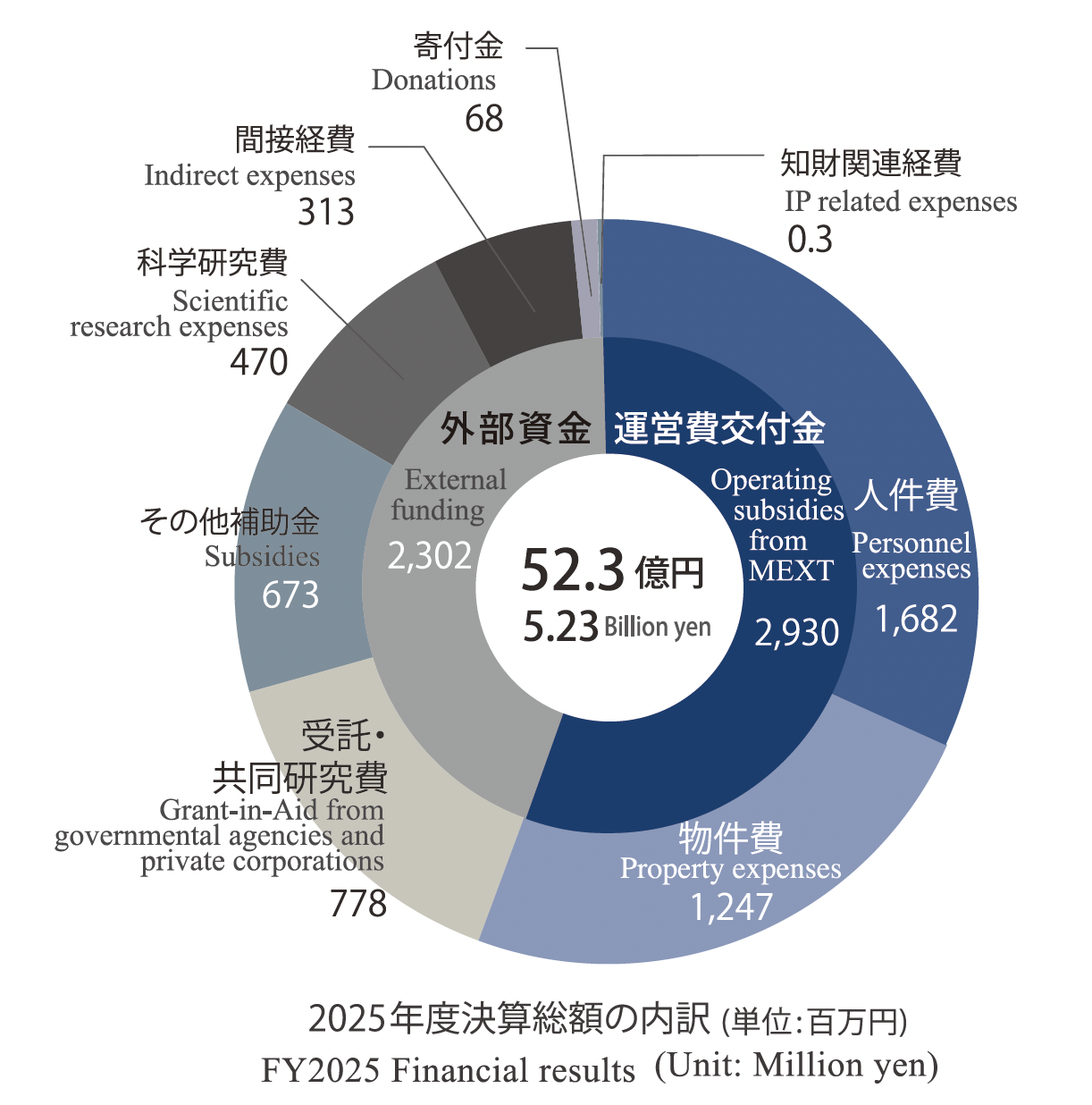
| Operating subsides from MEXT | Personnel expenses | 1,682 | 1,547 | 1,469 | 1,506 | 1,368 |
| Property expenses | 1,247 | 1,508 | 1,538 | 1,555 | 1,271 | |
| External funding | Grant-in-Aid from gaverment agensies and private corprations | 778 | 526 | 632 | 778 | 1,006 |
| Donations | 68.4 | 84.5 | 46.3 | 57.7 | 42.9 | |
| Science research expenses | 470 | 379 | 360 | 386 | 311 | |
| Subsides | 673 | 164 | 92.0 | 35.7 | 11.4 | |
| Indirect expenses | 313 | 63.2 | 80.5 | 233 | 324/td> | |
| IP related expenses | 0.35 | 0.15 | 0.61 | 0.59 | 0.38 | |
| Special purpose reserve funds | 0 | 0 | 0 | 0 | 4.4 | |
| Facility maintenance fee | 0 | 0 | 0 | 53.3 | - | |
| Total | 5,233 | 4,272 | 4,219 | 4,604 | 4,338 | |
External Review
Since 1995, ISSP has undergone an international external review at approximately ten year intervals. The committee, consisting of domestic and foreign experts, evaluate ISSP’s research activities and examine the future directions of ISSP.
- #4 Report of the External Review December 7-9, 2020
- #3 Report of the External Review January 20-22, 2016
- #2 Report of the Review Committee on the ISSP, UTokyo Novemver 14-16, 2005
- #1 Report of Review Committee for ISSP, UTokyo July 5-8,1995