


New Insights into Giant Thermoelectric Performance — Electronic Structure and Transport in Quasi-One-Dimensional Ta₄SiTe₄
A research team led by Hironari Isshiki, Masafumi Horio, Ryutaro Okuma, Miki Imai, Iwao Matsuda, Fumio Komori, Yoshichika Otani, Yoshihiko Okamoto, and Masayuki Hashisaka at the Institute for Solid State Physics (ISSP), the University of Tokyo, in collaboration with researchers from Kumamoto University, the Japan Atomic Energy Agency (JAEA), the High Energy Accelerator Research Organization (KEK), and Nagoya University, has experimentally investigated the electronic structure and electrical transport properties of the quasi-one-dimensional material Ta₄SiTe₄. Their findings provide new insights into the physical mechanisms underlying its exceptional thermoelectric performance.
This study represents the first published research outcome of a collaborative project centered on the Nanoscale Quantum Science Center (Q-NanoLab), established at ISSP in April 2026. The research was made possible through interdisciplinary collaboration among researchers with diverse expertise, combining materials synthesis, nanofabrication, and advanced measurement techniques. It marks the first publication arising from the cross-disciplinary research collaboration and joint-use activities promoted by Q-NanoLab.
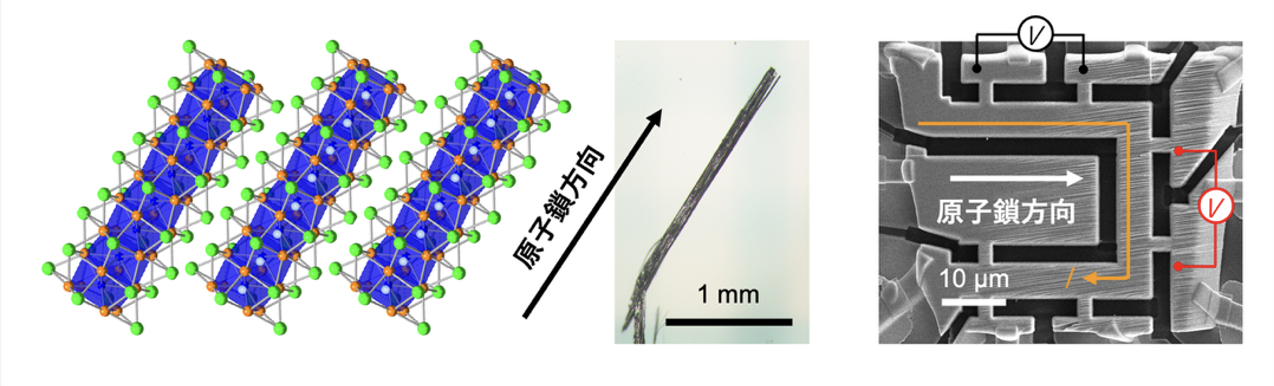
Thermoelectric materials, which convert heat into electricity, are attracting considerable attention for applications such as waste-heat energy harvesting. One promising approach to achieving high thermoelectric performance is to reduce the dimensionality of electronic systems by restricting electron motion to specific directions. Ta₄SiTe₄ has a quasi-one-dimensional crystal structure consisting of chains of atoms. Previous studies by Professor Yoshihiko Okamoto and colleagues revealed that this material exhibits an exceptionally large thermoelectric power factor at temperatures below room temperature. However, because Ta₄SiTe₄ is obtained only as tiny needle-shaped crystals, detailed experimental investigations of its electronic structure and direction-dependent electrical transport properties have been challenging. Consequently, the physical mechanisms responsible for its giant thermoelectric performance have remained poorly understood.
In this study, the researchers combined microfocused angle-resolved photoemission spectroscopy (micro-ARPES), which enables direct observation of the electronic structure in microscopic regions, with electrical transport measurements on microscale samples fabricated using focused ion beam (FIB) processing. This approach allowed them to quantitatively evaluate the dimensionality of the electronic structure and electrical transport in Ta₄SiTe₄. They also obtained experimental insights into the carrier density, anisotropy of carrier mobility, and energy gap relevant to its thermoelectric properties. The micro-ARPES measurements revealed that the electronic structure of Ta₄SiTe₄ exhibits characteristic one-dimensional features reflecting its crystal structure. In contrast, electrical transport measurements on FIB-fabricated samples showed that the electrical resistivity perpendicular to the atomic chains is only about five times larger than that parallel to the chains. This unexpectedly small transport anisotropy, compared with the pronounced one-dimensional characteristics of the electronic structure, reveals that electrical conduction in Ta₄SiTe₄ is much less one-dimensional than might be anticipated from its crystal structure.
These findings provide an important clue to understanding the exceptional thermoelectric performance of Ta₄SiTe₄. In strongly one-dimensional materials, electron transport is generally susceptible to disruption by defects and impurities along the atomic chains. In Ta₄SiTe₄, however, finite electrical conduction between neighboring chains may allow electrons to bypass such defects, thereby maintaining good electrical conductivity. This suggests that the coexistence of one-dimensional features in the electronic structure and relatively weak anisotropy in electrical transport may contribute to achieving both a large thermoelectric response and good electrical conductivity.
By comprehensively characterizing the electronic structure and electrical transport properties of Ta₄SiTe₄, this study suggests that achieving high thermoelectric performance may require not simply enhancing electronic one-dimensionality, but rather optimizing the balance between one-dimensional electronic characteristics and interchain electrical conduction. These insights are expected to provide valuable guidelines for the design and development of new high-performance thermoelectric materials.
Beyond its scientific significance, this study also demonstrates how the research framework of Q-NanoLab, which integrates materials development, nanofabrication, and advanced measurements, can lead to new scientific discoveries. Through continued interdisciplinary collaboration and shared use of research facilities by researchers both within and outside ISSP, Q-NanoLab aims to advance research on quantum materials and functional materials.
Publication
- Journal:Physical Review Materials
- Title:Weak Electronic One-Dimensionality of Ta4SiTe4 Underlying its Giant Thermoelectric Performance
- Authors:Hironari Isshiki*, Ayumu Tabata, Masafumi Horio, Motoi Kimata, Youichi Yamakawa, Ryutaro Okuma, Miki Imai, Fumiya Matsunaga, Koshi Takenaka, Kenichi Ozawa, YoshiChika Otani, Fumio Komori, Iwao Matsuda, Masahiro Hara, Yoshihiko Okamoto, Masayuki Hashisaka(*Corresponding author)
- DOI:https://doi.org/10.1103/653b-z2m9
Relates Pages
- Nanoscale Quantum Science Center (Q-NanoLab)
- Hashisaka Group| ISSP, UTokyo
- I. Matsuda Group| ISSP, UTokyo
- Okamoto Group| ISSP, UTokyo