


Observation of a Photocurrent Reflecting Magnetic States in an Atomically Thin Magnetic Material — Discovery of a Sign-Reversing Photocurrent in an Antiferromagnet —
In recent years, atomically thin materials—crystals only a few atoms thick—have attracted growing attention because they can exhibit physical properties that do not appear in conventional bulk materials. Among them, atomically thin magnetic materials are particularly intriguing, as they can host unconventional magnetic states and offer new possibilities for spin-based electronic technologies.

In this study, researchers investigated the photocurrent response of a bilayer atomically thin antiferromagnet. In this material, spins are aligned within each atomic layer, while the spin orientations of the top and bottom layers are opposite. Depending on the relative spin configuration between the two layers, the system exhibits two distinct antiferromagnetic (AFM) states (Fig. 1a).
To explore how these magnetic states interact with light, the researchers fabricated devices by attaching electrodes to bilayer samples and illuminated the center of the material, away from the electrodes. They measured both the zero-bias photocurrent and current–voltage characteristics under illumination. The experiments revealed that no electrical current flows in the absence of AFM order. In contrast, when the system is in an AFM state, illumination alone generates a finite current even without any applied voltage. Moreover, the direction of the photocurrent reverses between the two AFM states (Fig. 1b), directly reflecting the magnetic configuration of the material.
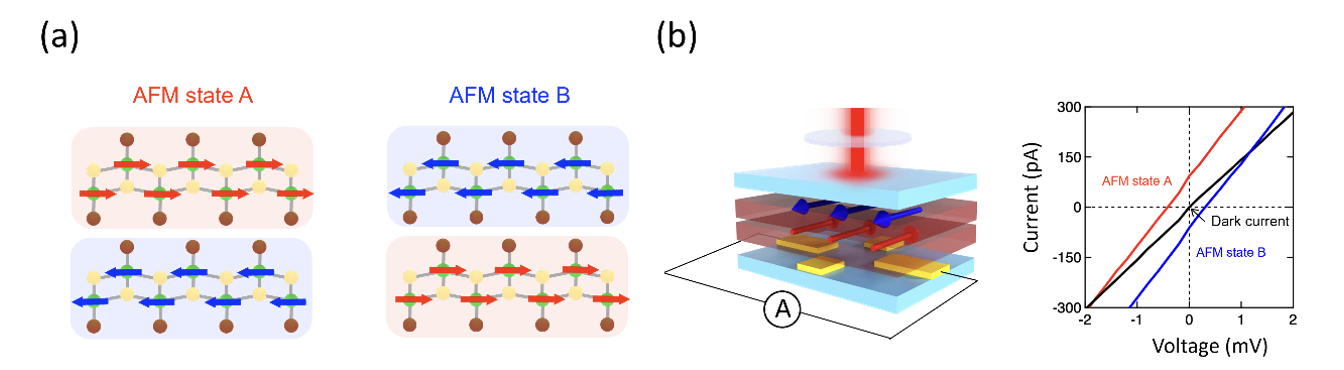
The researchers further showed, using a theoretical model, that the observed photocurrent behavior—including its dependence on photon energy—can be explained by the quantum geometric properties of the electronic wavefunctions. This identifies a previously unexplored mechanism for photocurrent generation in magnetic materials.
In addition, by comparing photocurrent responses in AFM states and in ferromagnetic (FM) states induced by an external magnetic field, and by using two types of devices contacting either the top or bottom layer, the team demonstrated that the photocurrent flows locally within each individual atomic layer (Fig. 2). By modifying the device structure, the photocurrent from each layer can be selectively extracted.
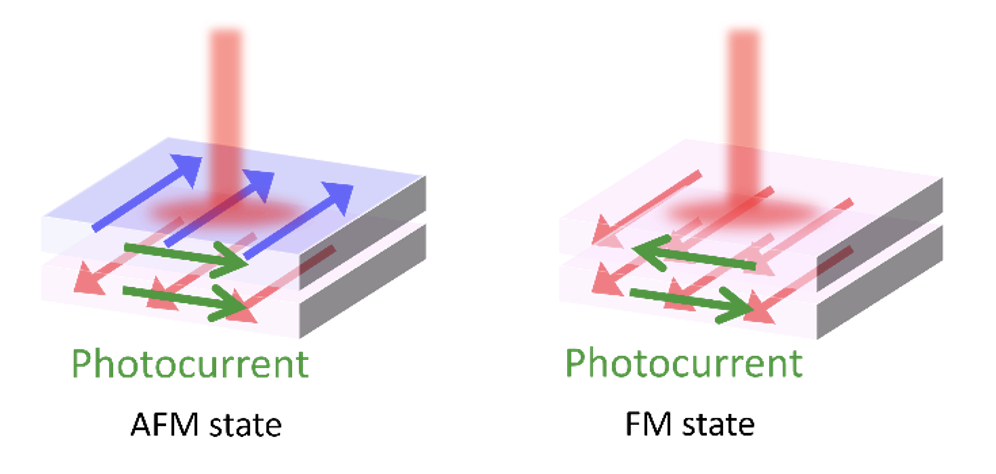
These findings demonstrate that even antiferromagnets without macroscopic magnetization can host photocurrents that encode information about their magnetic states. The results highlight the importance of layer-resolved local structure and device design in atomically thin materials and are expected to open new avenues for opto-spintronic devices and ultralow-power electronic and quantum technologies.
Publication Information
- Journal:Nature Materials
- Title:Layer Photovoltaic Effect in a Two-dimensional Antiferromagnet with Parity-Time Symmetry
- Authors:Yu Dong, Sota Kitamura, Yuki M. Itahashi, Daniel G. Chica, Shingo Toyoda, Kenji Watanabe, Takashi Taniguchi, Miuko Tanaka, Xavier Roy, Naoki Ogawa, Takahiro Morimoto, Yoshihiro Iwasa*, Toshiya Ideue*
- DOI: 10.1038/s41563-026-02593-8
- URL: https://www.nature.com/articles/s41563-026-02593-8
Funding
This work was supported by JSPS KAKENHI (Grant Nos. JP21H05233, JP22J22007, JP23H02052, JP23K25816, JP23K17665, JP23H00088, JP24K17008, JP24H02231, JP24H01176, JP25H00839, and JP25H02117), JST FOREST (Grant No. JPMJFR213A), JST CREST (Grant Nos. JPMJCR24A5 and JPMJCR25A3), and the World Premier International Research Center Initiative (WPI), MEXT, Japan. Synthetic and structural studies conducted at Columbia University were supported by the Materials Research Science and Engineering Center (MRSEC) on Precision-Assembled Quantum Materials through the U.S. National Science Foundation (NSF) under Award No. DMR-2011738, and by the Air Force Office of Scientific Research (AFOSR) under Award No. FA9550-22-1-0389.