

Yoshinobu Group

- Affiliation
- Division of Nanoscale Science
(concurrent with Functional Materials Group) - Courses
- Chem., Sci.Adv. Mat., Frontier Sci.
Research Subjects
- Activation and surface reaction of molecules on well-defined model catalysts
- Properties and reactions of materials with hydrogen
- Electronic states and reactivity of edge surfaces of two-dimensional materials
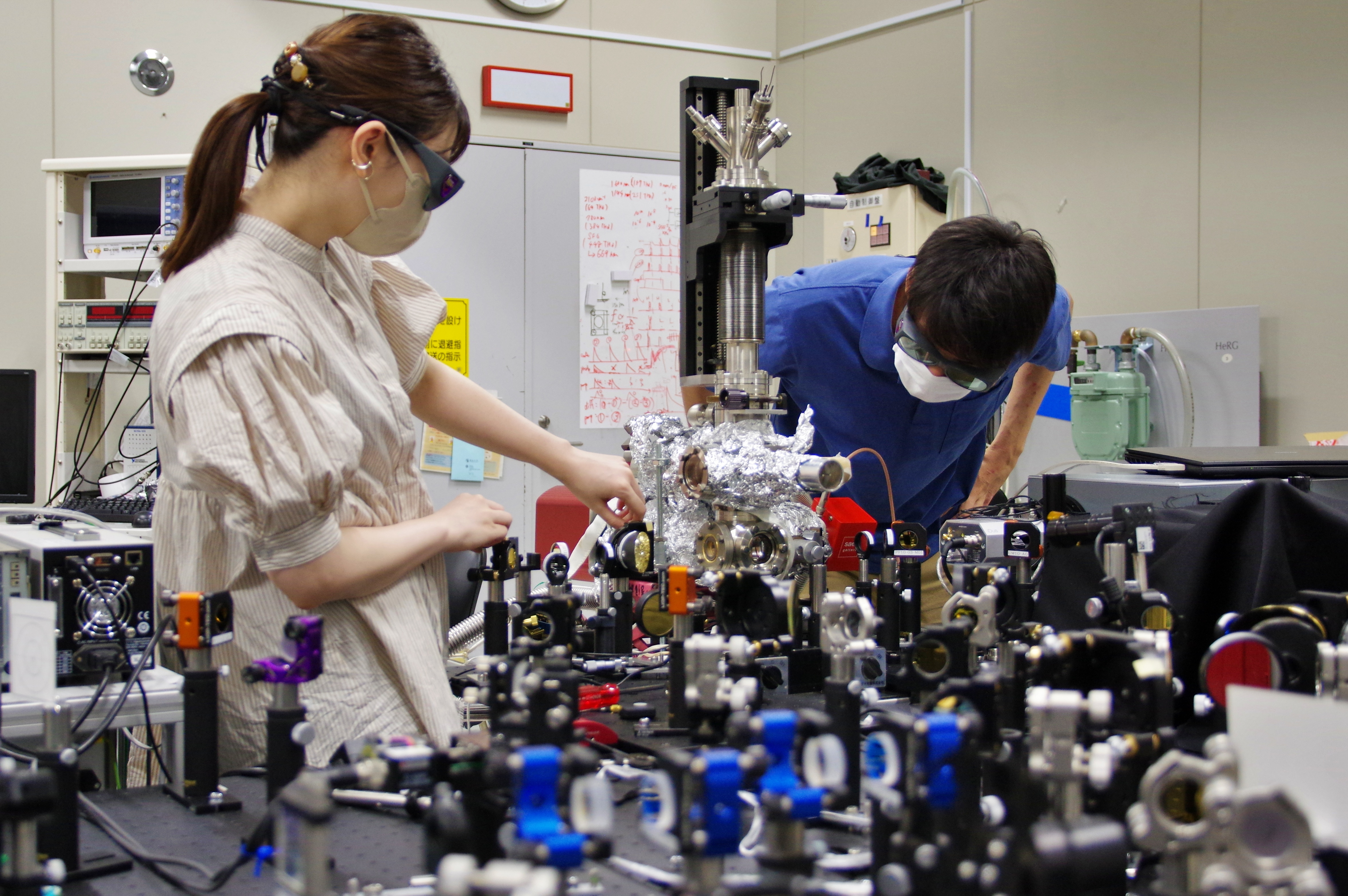
- Vibrational spectroscopy and dynamical processes of molecules on surfaces using THz pulses
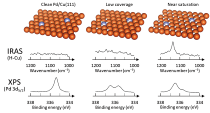
Solid surfaces play an important role as “low dimensional reaction field”, on which we can provide atoms and molecules and manipulate them deliberately. In addition, surface and interface are vital in the energy conversion processes. In order to fabricate atomically-controlled functional materials, we have to understand the dynamical behavior of atoms and molecules on surfaces. The research of these subjects is closely related to the basics of catalysis, semiconductor processes and molecular electronics. In addition, we can simulate chemical reactions on cosmic dust and clouds in atmosphere with laboratory experiments in ultrahigh vacuum at low temperature. We have utilized surface vibrational spectroscopy, photoelectron spectroscopy and local probe methods in order to investigate structures, reactions and electronic properties of atoms/molecules and thin films on surfaces. Synchrotron radiation is also used to study electronic structure of surface and interface, including operando X-ray photoelectron spectroscopy. Recently, we have engaged in the study of THz-pulse driven surface processes.