

Mori Group

- Affiliation
-
Division of Condensed Matter Science
(concurrent with Functional Materials Group) - Courses
- Chem., Sci.Adv. Mat., Frontier Sci.
 Research Associate FUJINO, Tomoko
Research Subjects
- Development and studies of structural and physical properties for novel organic (super)conductors and proton conductors based upon molecular degree of freedom
- Development and studies of structural and physical properties for electron-proton coupled molecular functional materials
- Studies of responses by external stimuli (magnetic and electric fields, temperature, pressure) for molecular materials
- Study of organic field effect transistor
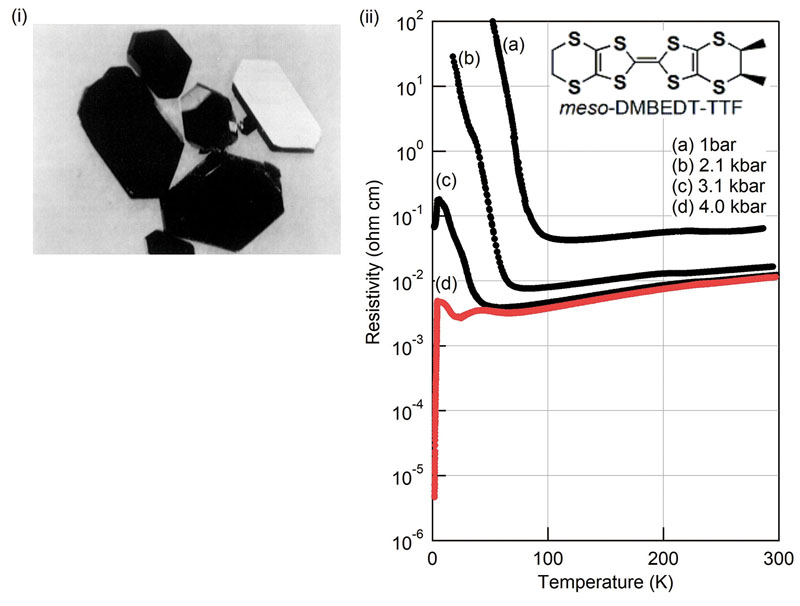
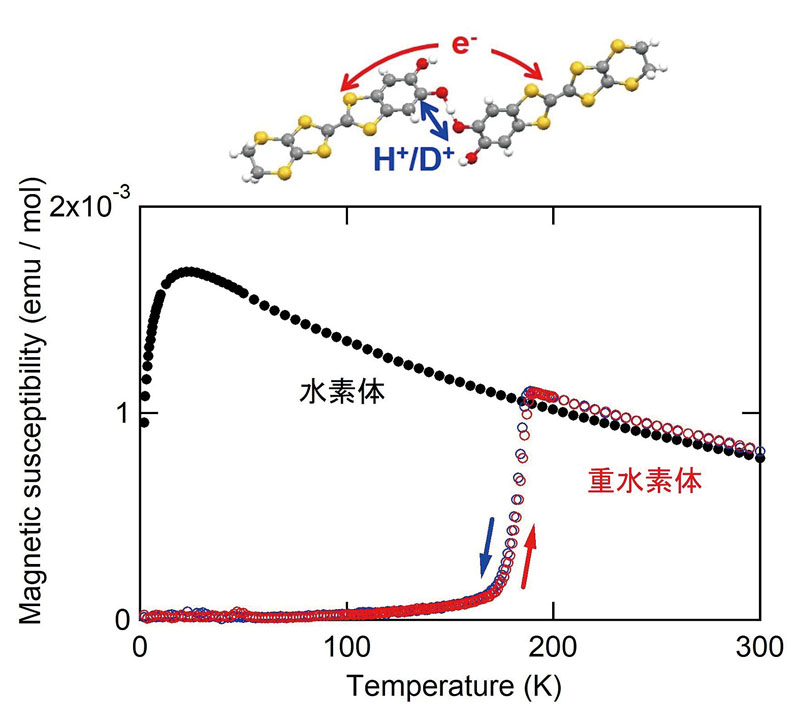
Materials science has made great progress with the discovery of new materials that give us new concepts. In this laboratory, we are focusing on molecular materials, which are condensed molecules with internal degrees of freedom, and exploring their unique functionalities such as electron and proton conductivities, magnetism, dielectricity, external field response due to their pressure and electric fields, and field-effect transistor properties. The development of novel functional molecular materials has become the basic research for materials and devices that support organic electronics, such as coated organic conductors and electrolytes for fuel cells. Molecular materials are attractive because 1) they can be designed and controlled, 2) the Coulomb interaction between electrons is large, and the wave and particle properties of electrons compete with each other, and 3) they are soft, so they exhibit unique external field responses. In Mori's group, we discovered and studied the properties of the new Mott-type κ-ET2Cu(NCS)2 and charge-ordered β-(meso-DMBEDT-TTF)2PF6 organic superconductors (left figure). More recently, we have developed a pure organic conductor (right figure) in which hydrogen-bonded protons and conduction electrons are dynamically concerted, exhibiting a switching phenomenon between conductivity and magnetism.